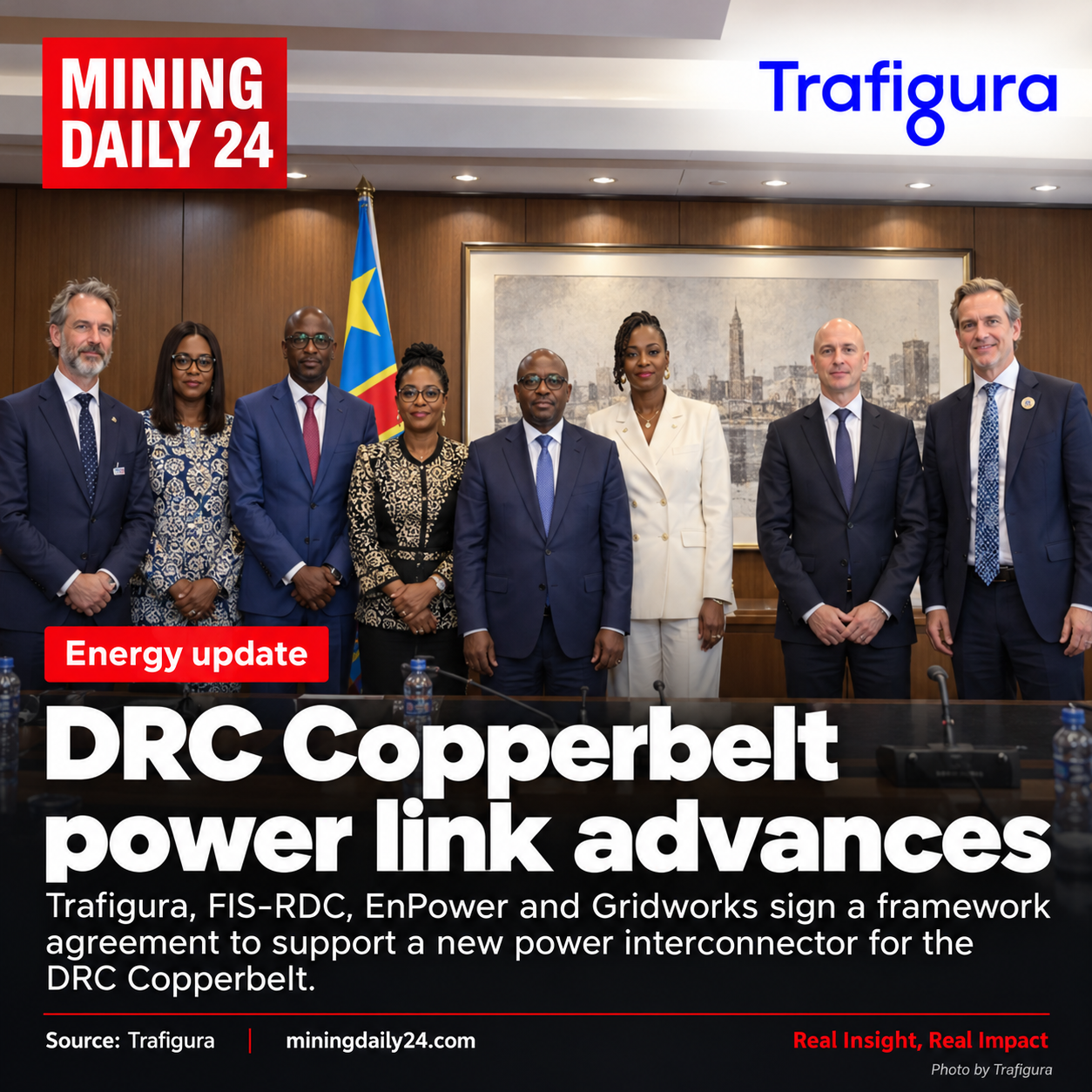
A major cross-border electricity project aimed at easing power shortages across the Democratic Republic of Congo’s Copperbelt has moved into its final development stage after FIS-RDC, EnPower, Trafigura and Gridworks signed a strategic framework agreement in Kinshasa.
The partners plan to jointly finance, build and operate the Kalumbila-Kolwezi Interconnector Project, a roughly 200 km high-voltage transmission line connecting Kalumbila in Zambia with Kolwezi in the DRC.
700 MW cross-border connection
“Reliable, competitively priced power is a critical enabler of economic growth across the continent.” Gonzalo De Olazaval, Trafigura Global Head of Metals and Minerals.
The proposed transmission line will have a thermal capacity of 700 MW and is expected to allow up to 550 MW of electricity to be imported into the DRC’s Copperbelt from the wider Southern African power market.
Its design also allows capacity to be increased beyond 1 GW in future as electricity demand from mining, refining and industrial projects grows.
The project is expected to cost approximately US$300 million to construct.
According to the project partners, the necessary concessions, licences and authorisations have already been secured, placing the development in its final stage before implementation.
Power shortage constraining mining growth
The DRC’s Copperbelt hosts some of the world’s most important copper and cobalt operations, but a shortage of reliable electricity has increasingly become a constraint on the development and expansion of mining and processing capacity.
Trafigura says the DRC currently faces a structural electricity deficit of more than 1 GW.
The new interconnector is intended to give mining and industrial consumers access to additional, competitively priced power from across Southern Africa through stronger integration with the Southern African Power Pool.
The project could also help unlock mining and refining developments that have been delayed or constrained by insufficient access to reliable baseload electricity.
Zambia gains new export route
The infrastructure is expected to benefit both countries.
For Zambia, the interconnector would create additional export capacity for licensed electricity producers and provide another route for power generated in the country and wider regional market to reach customers in the DRC.
The partners are also in discussions with Zambian entities about potentially taking an equity stake in the project.
Private capital backing the project
Gridworks is expected to become the project's lead equity investor and majority shareholder.
FIS-RDC and EnPower have also confirmed their intention to invest equity, while Trafigura has agreed to arrange a significant portion of the project’s debt financing.
EnPower, which has been importing electricity into the DRC since 2023, is the project developer and is already a licensed Congolese electricity trader and member of the Southern African Power Pool.
Gridworks is owned by British International Investment, the UK government’s development finance institution.
For FIS-RDC, the project is particularly significant because it represents the fund’s first announced investment since its creation in October 2025.
Mining demand anchors the project
The interconnector will initially be anchored by demand from the mining sector, but the partners say capacity will also be available to support communities and other businesses.
Trafigura Global Head of Metals and Minerals Gonzalo De Olazaval said reliable and competitively priced electricity remains an important requirement for wider economic growth and industrial development across Africa.
The project comes as copper and cobalt producers across the DRC continue investing in mine expansions, processing plants and refining capacity.
For the Copperbelt, additional transmission infrastructure could therefore become as important as new mining investment itself, particularly if the region is to increase mineral processing and beneficiation while maintaining reliable production.