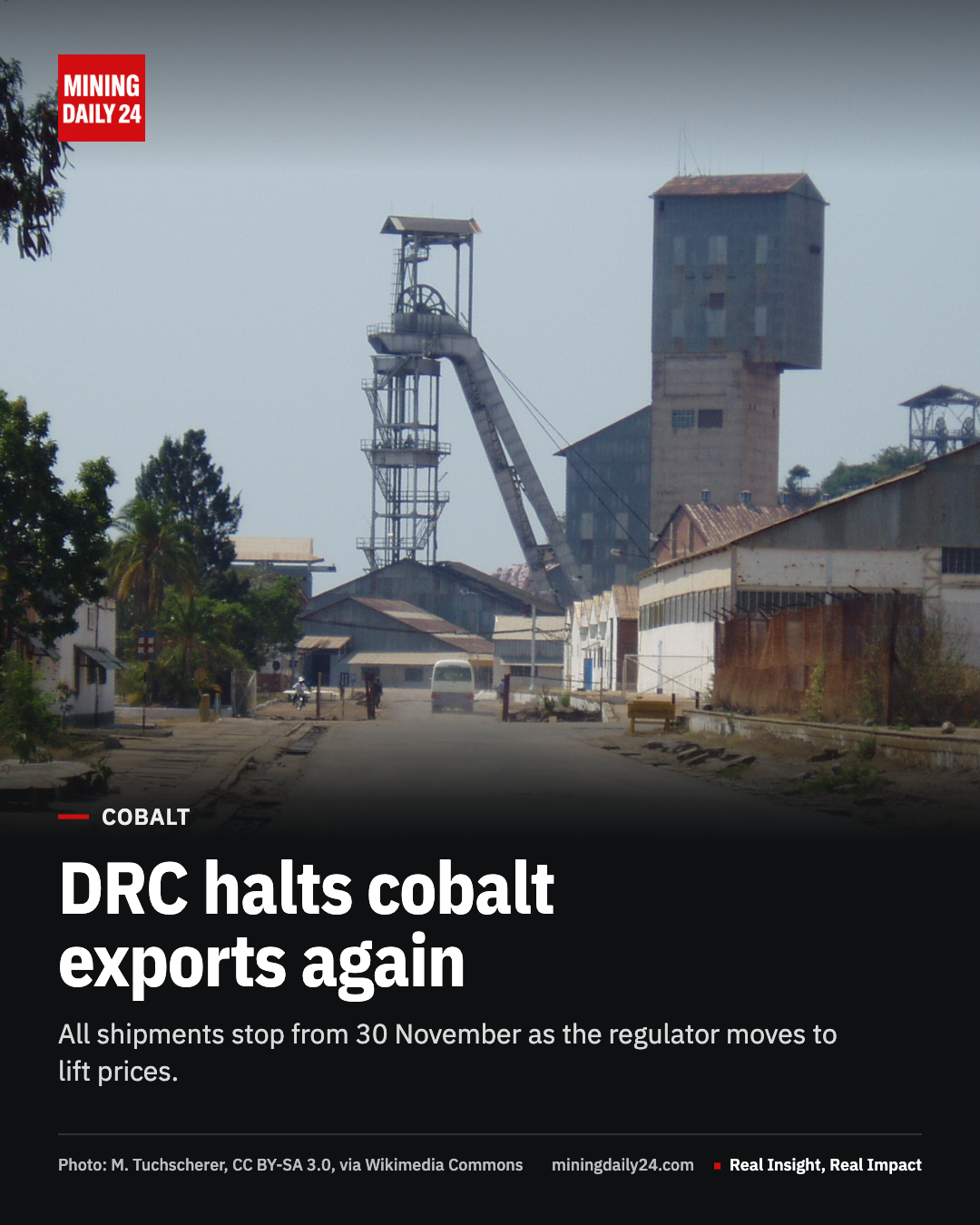
The Democratic Republic of Congo will stop all cobalt exports from 30 November until further notice, its strategic minerals regulator ARECOMS said in a statement on Monday, 23 November, as Kinshasa moves for a second time to shore up a falling price.
ARECOMS, the Authority for the Regulation and Control of Strategic Mineral Substance Markets, said the suspension is meant "to address the oversupply in the international market" and to support a sustainable rebalancing of the market. The decision was taken at a board meeting on 9 November and the statement was signed by the regulator's president, Patrick Luabeya, according to Bloomberg.
Why now
"To address the oversupply in the international market and to promote a sustainable rebalancing of the market." ARECOMS, the DRC's strategic minerals regulator
The regulator pointed to a "significant and sustained decline in cobalt prices" since June, together with slower global consumption, rising inventories and what it called speculative practices in the market. Cobalt hydroxide, the main product shipped from the DRC, more than quadrupled in price after the first intervention before almost halving from an April peak, Bloomberg reported, citing Fastmarkets data.
ARECOMS said it will review the ban after four months, looking at the wider cobalt market, available stocks and the balance between supply and demand. It will also use the pause to review and adjust how export quotas are allocated.
From ban to quotas and back
This is the second full stop on exports. The first ban, introduced in February 2025, was replaced eight months later by a quota system. From 16 October 2025, ARECOMS allowed 18,125 tonnes to be exported for the rest of that year, and set a base quota of 87,000 tonnes a year for 2026 and 2027, about 7,250 tonnes a month, plus a strategic quota of up to 9,600 tonnes for 2026, Fastmarkets reported at the time. Traders described that monthly volume as roughly half of what the country exported in 2024.
Cobalt in the DRC is mined as a by-product of copper. CMOC Group, Glencore and Eurasian Resources Group hold the largest export quotas. The country supplied about three-quarters of the world's mined cobalt before the restrictions, and Indonesia, the second-largest producer, could gain market share while Congolese shipments are halted, Bloomberg noted.
Why it matters
The DRC's Copperbelt is the backbone of the region's battery-metals supply, and its export policy now sets the pace for producers, traders and logistics corridors through Zambia, Tanzania and South Africa. The ban also adds pressure to build local refining: the country had no active cobalt refining capacity when the quota system was announced, according to Fastmarkets, so for now the value of its cobalt still depends on what happens to stockpiles held outside its borders.
Sources: ARECOMS statement (23 November 2026) as reported by Bloomberg and Mining Weekly; Shanghai Metals Market; Fastmarkets (22 September 2025).