
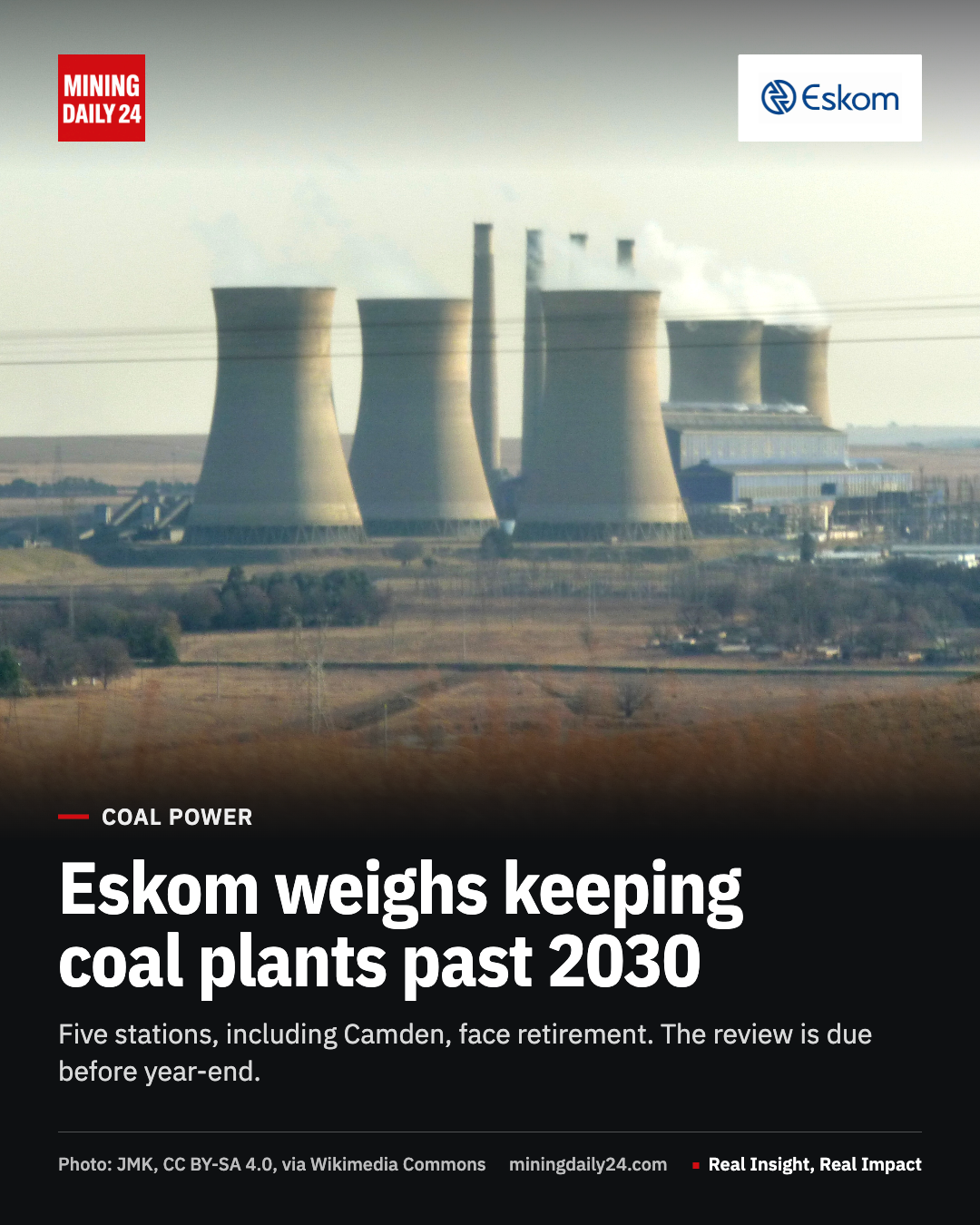
Eskom will publish the findings of a review of its coal fleet before the end of 2026, a process that could keep some power stations running beyond their planned 2030 retirement dates.
Electricity and Energy Minister Kgosientsho Ramokgopa confirmed that his department and Eskom are reviewing the coal fleet "on its own merits". In a speech to the South African Nuclear and Clean Energy Conference, he said some stations may have a case for longer operation while others will retire, and that any decision would reflect plant condition, cost and the applicable environmental requirements.
Five stations in focus
"Some stations may have a case for longer operation and others will retire." Kgosientsho Ramokgopa, Minister of Electricity and Energy
Grootvlei, Arnot, Camden, Hendrina and Kriel received a suspension decision on minimum emission standards in 2024, on the expectation that they would stop operating after 31 March 2030, Engineering News & Mining Weekly reported. Eight more stations, Kendal, Duvha, Matla, Matimba, Medupi, Lethabo, Majuba and Tutuka, run under exemption decisions that require emissions projects.
Eskom had first signalled that the review outcome would be published in September. Eskom CEO Dan Marokane told Engineering News & Mining Weekly that the review was now moving through governance processes and would be released before year-end. He said delays to gas-to-power and battery storage procurement pointed to a gap in system adequacy in the 2030s if the coal stations closed on schedule. Publication will start talks with stakeholders, including the Department of Forestry, Fisheries and the Environment.
Eskom chairperson Mteto Nyati told the same conference that the 2030 timeline posed a risk to security of supply. "We cannot just make those decisions of retiring power stations that still have maybe another ten years of life," Nyati said.
Grid flexibility and curtailment
The review follows the National Transmission Company South Africa's Medium-Term System Adequacy Outlook 2027–2036, which says adequacy depends on fleet performance and the timely delivery of generation, storage, flexibility and grid upgrades.
Marokane said Eskom is studying, with an international utility partner, whether older coal units can run more flexibly, and wants to raise demand in the midday solar surplus. The NTCSA's outstanding curtailment compensation claims from renewable generators have passed R2 billion, and total claims for the current financial year are expected to reach R4 billion.
The minister also confirmed that the Integrated Resource Plan 2025 provides for 5,200 MW of new nuclear capacity, with a determination intended before June 2027.
Why it matters
Mines are among Eskom's largest customers and many collieries supply its power stations. Whether the oldest Mpumalanga stations run past 2030 will shape coal demand, the cost and reliability of electricity for smelters and shafts, and how quickly mines need their own solar, wind and storage. The findings are due within weeks.