
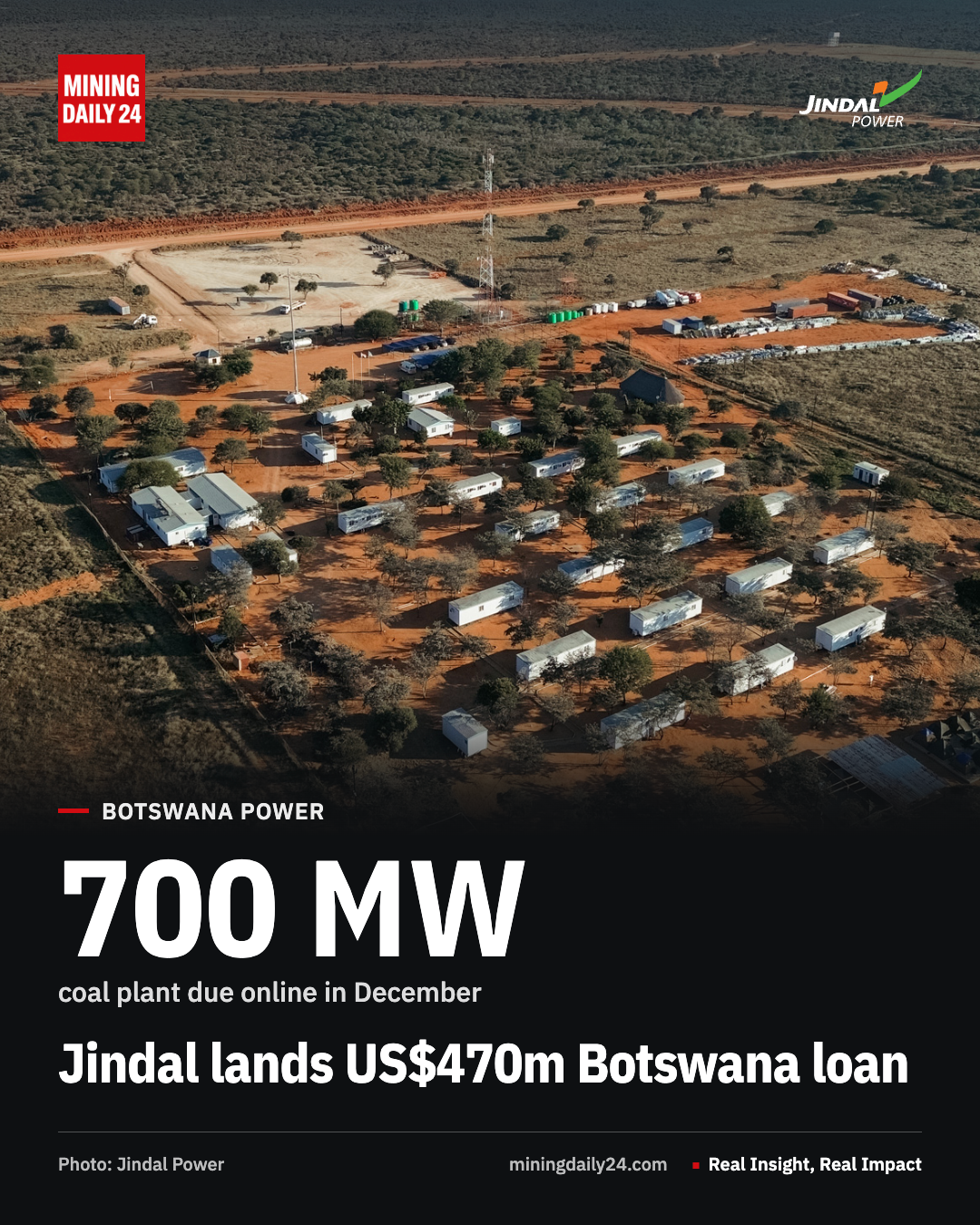
Jindal Power has signed an offshore loan of about US$470 million to help fund its Botswana power project, Bloomberg reported on 13 November, as the 700 MW coal-fired Jindal Mmamabula Energy Project (JMEP) heads for commissioning in December.
According to Bloomberg, which cited people familiar with the matter, three Indian lenders provided the facility: Axis Bank, ICICI Bank and the Export-Import Bank of India. Jindal Power and the banks did not reply to Bloomberg's requests for comment.
The loan
Bloomberg said the nine-year facility is priced at about 300 to 325 basis points over the Secured Overnight Financing Rate (SOFR), and that the borrowing cost is expected to fall once the plant is commissioned. The loan is being syndicated, with some global institutional lenders expected to join.
Jindal Power raised about US$500 million in an earlier round of financing in February for its expansion abroad, Bloomberg reported. Because the Botswana project's revenue is expected to be in, or linked to, foreign currency, the company has a natural hedge against exchange-rate swings.
The plant
Jindal Power says JMEP is a 700 MW (net) coal-based power plant, developed by Jindal Energy Botswana and scheduled for commissioning in December 2026. The first phase of 350 MW is base-load power for Botswana Power Corporation. A second 350 MW phase is aimed at regional demand and power exports.
The company says the project is integrated with the Southern African Power Pool (SAPP) to allow cross-border power trade, and that it plans to expand capacity to 1,200 MW over time and add solar alongside the coal units.
Coal and mining demand
Botswana's coal resources are estimated at more than 200 billion tonnes, Bloomberg noted, and the country's mining operations are large electricity consumers. Jindal Power lists support for industrial and mining growth among the project's aims, alongside energy self-reliance for Botswana and local jobs.
Why it matters
Botswana has relied on power imports to cover gaps in its own generation. A 700 MW plant coming online in December would give the country's mines more secure local supply and could free surplus power for neighbours through the SAPP, at a time when mines in Zambia and elsewhere in the region still face supply constraints. It is also a sign that new coal generation in the region can still find bank funding, in this case from Indian lenders.