Sovereign Metals has appointed Tim Carstens, the former managing director of Base Resources, as executive chair to lead its Kasiya rutile and graphite project in Malawi through development, financing and construction. The appointment takes effect on 19 November, the company said on 16 November.
Carstens has more than 25 years in senior resources roles in Australia and abroad, including at Perilya, North, Robe River Iron Associates, Iron Ore Company of Canada and St Barbara Mines, according to Sovereign.
An African build record
"Tim's appointment represents an inflexion point for Sovereign." — Frank Eagar, managing director and CEO, Sovereign Metals
From 2008 until its acquisition by US critical minerals company Energy Fuels in October 2024, Carstens ran Base Resources. Under him, Base financed, built and operated the Kwale mineral sands mine, Kenya's first large-scale commercial mine, and advanced the Toliara mineral sands and rare earths project in Madagascar, Sovereign said.
Managing director and CEO Frank Eagar said the appointment "represents an inflexion point for Sovereign" as Kasiya moves from feasibility studies towards construction and production. He pointed to Carstens' experience in financing and delivering large mining projects in Africa and his relationships in the US, which fit the company's US-focused strategy.
Carstens said the focus now turns to permitting, financing and commercial arrangements, and to building the organisation needed to take Kasiya into construction, as reported by Mining Weekly.
Board changes and pay
Chair Ben Stoikovich will retire from the board on 19 November to focus on his role as CEO of GreenX Metals, but will stay on as a consultant. Founding director Mark Pearce retires after the annual meeting on 18 November, and Ian Middlemas takes over as audit committee chair.
Carstens will receive fixed pay of A$300,000 a year, made up of a A$125,000 director's fee and A$175,000 in consulting fees, plus 2 million performance rights linked to a financing and construction milestone and 3 million options exercisable at A$0.60, according to the ASX filing.
The project
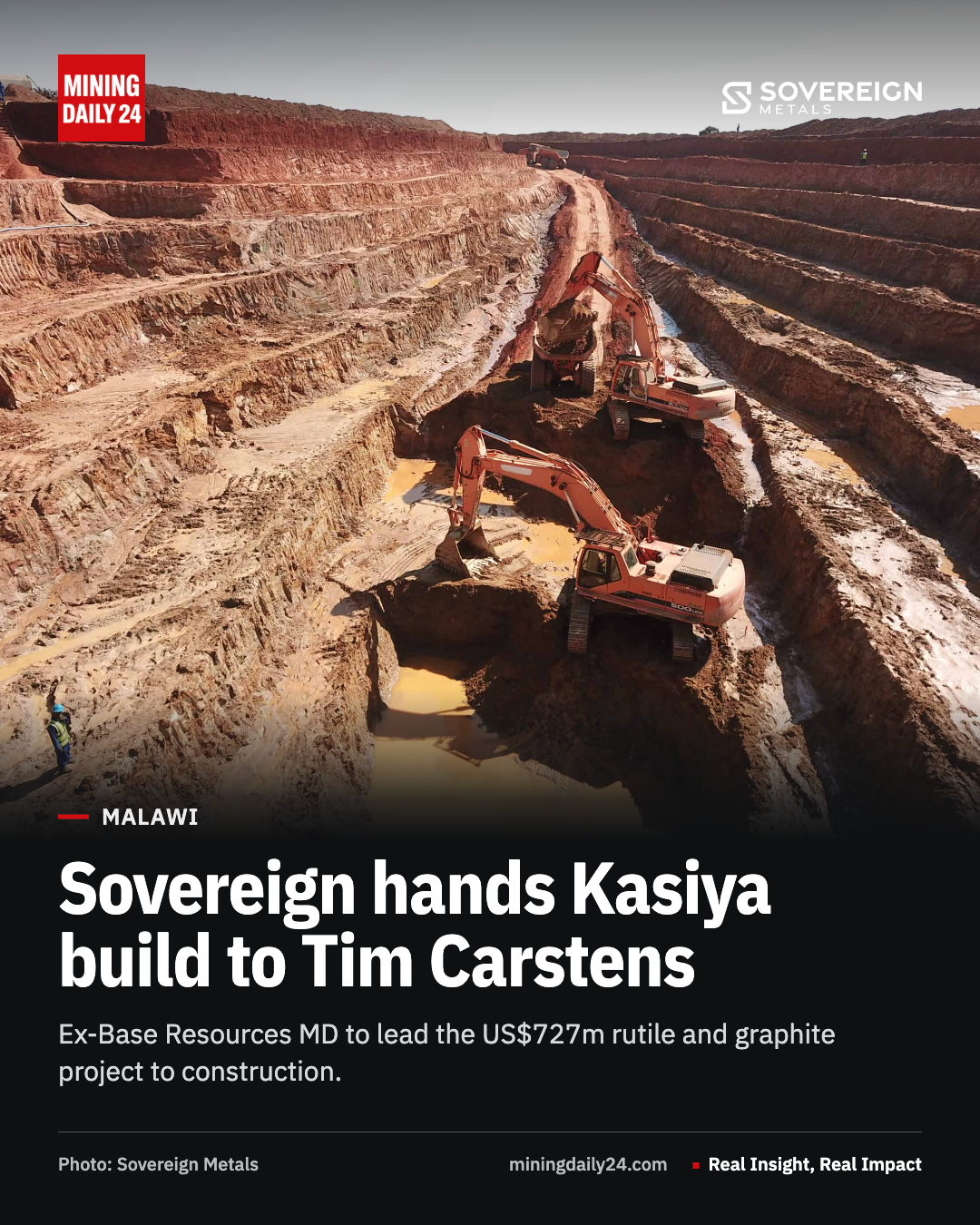
Kasiya lies about 40 km northwest of Lilongwe. Sovereign's definitive feasibility study, released in April, puts Stage 1 capital cost at US$727 million for a 12 Mtpa operation, doubling to 24 Mtpa in Stage 2. At steady state the mine would produce an average of 222,000 tonnes of rutile and 275,000 tonnes of graphite a year over a 25-year life. The study gives a pre-tax NPV of US$2.2 billion and a pre-tax IRR of 23%.
In July, Rio Tinto, then holding about 18.2% of Sovereign, decided not to take up its option to become operator, leaving Sovereign to develop Kasiya itself. The company has offtake memorandums with Mitsui & Co and Traxys North America and a financing collaboration with the International Finance Corporation.
Why it matters
Kasiya would be one of Southern Africa's largest new critical minerals mines and a major new source of natural rutile and graphite outside China. Putting an executive who has already built a mineral sands mine in East Africa in charge is a signal that Sovereign is moving to funding and construction, with jobs, exports and royalties for Malawi riding on the final investment decision.