
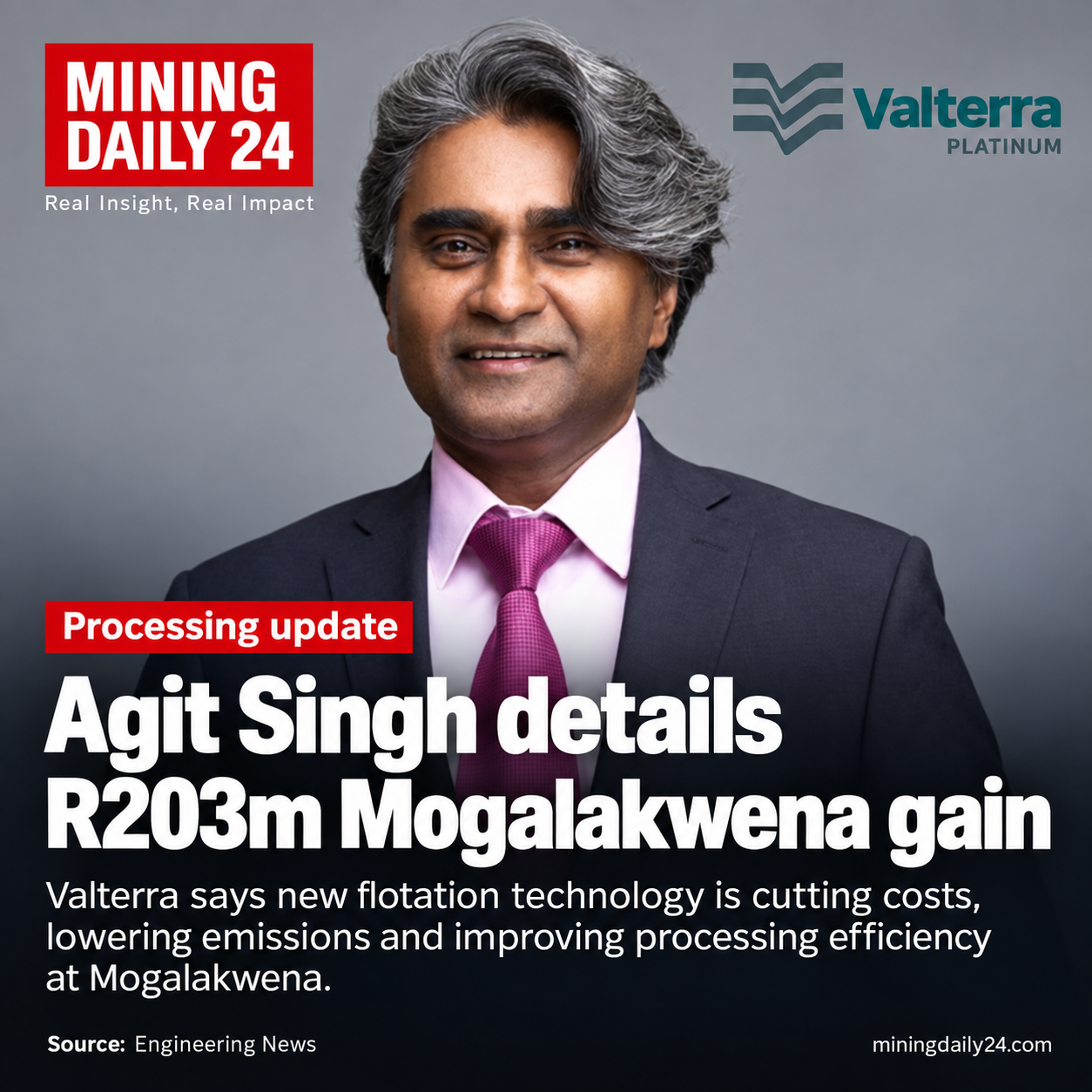
Valterra Platinum says new flotation technology at its Mogalakwena PGM mine in Limpopo is delivering significant improvements in processing efficiency, energy consumption, transport requirements and emissions.
Speaking during Valterra Platinum's value-chain media briefing, Executive Head: Processing Operations Agit Singh outlined the benefits being achieved through the deployment of Jameson flotation cells at Mogalakwena's North Concentrator.
The operation has replaced approximately 44 conventional flotation cells with just four Jameson cells, significantly reducing the concentrator footprint while maintaining PGM grade and recovery.
“Big, big benefits.”
R203 million annual saving
Valterra says the technology is delivering an estimated R203 million in annual cost savings, excluding additional revenue benefits associated with improved metal recovery.
The changes have also reduced the amount of concentrate that needs to be transported from Mogalakwena to Valterra's smelting facilities.
According to the company, the reduction is equivalent to removing approximately 3,000 truck movements from the transport chain.
Further benefits include a reported reduction in smelting electricity consumption and approximately 70,000 tonnes fewer carbon dioxide emissions.
“Big, big benefits,” Singh said while explaining the impact of the technology during the processing briefing.
Less material, same valuable metals
Jameson cells use high-intensity flotation technology to separate valuable minerals from unwanted material more selectively.
For Valterra, the objective is to reduce the mass of concentrate leaving the concentrator without sacrificing PGM recovery or concentrate grade.
This means less material has to be transported and processed downstream, reducing pressure on smelting capacity while lowering energy and logistics requirements.
Valterra's own sustainability reporting shows that the technology had already produced measurable improvements at Mogalakwena North during its earlier deployment, including reductions in mass pull, electricity consumption, concentrate haulage and carbon emissions.
Mogalakwena South could be next
Following the performance achieved at the North Concentrator, Singh said work to assess the introduction of Jameson cells at Mogalakwena's South Concentrator is well advanced.
Valterra has previously indicated that implementation of the South Concentrator flotation-cell replacement project is targeted for 2027, while similar mass-pull reduction studies are being considered across its wider concentrator network.
The company operates seven concentrators as part of its Southern African processing network, alongside major smelting and refining infrastructure.
For Valterra, the Mogalakwena project demonstrates how changes made at the concentration stage can create benefits across the wider mining value chain, from transport and smelting to energy consumption, emissions and operating costs.