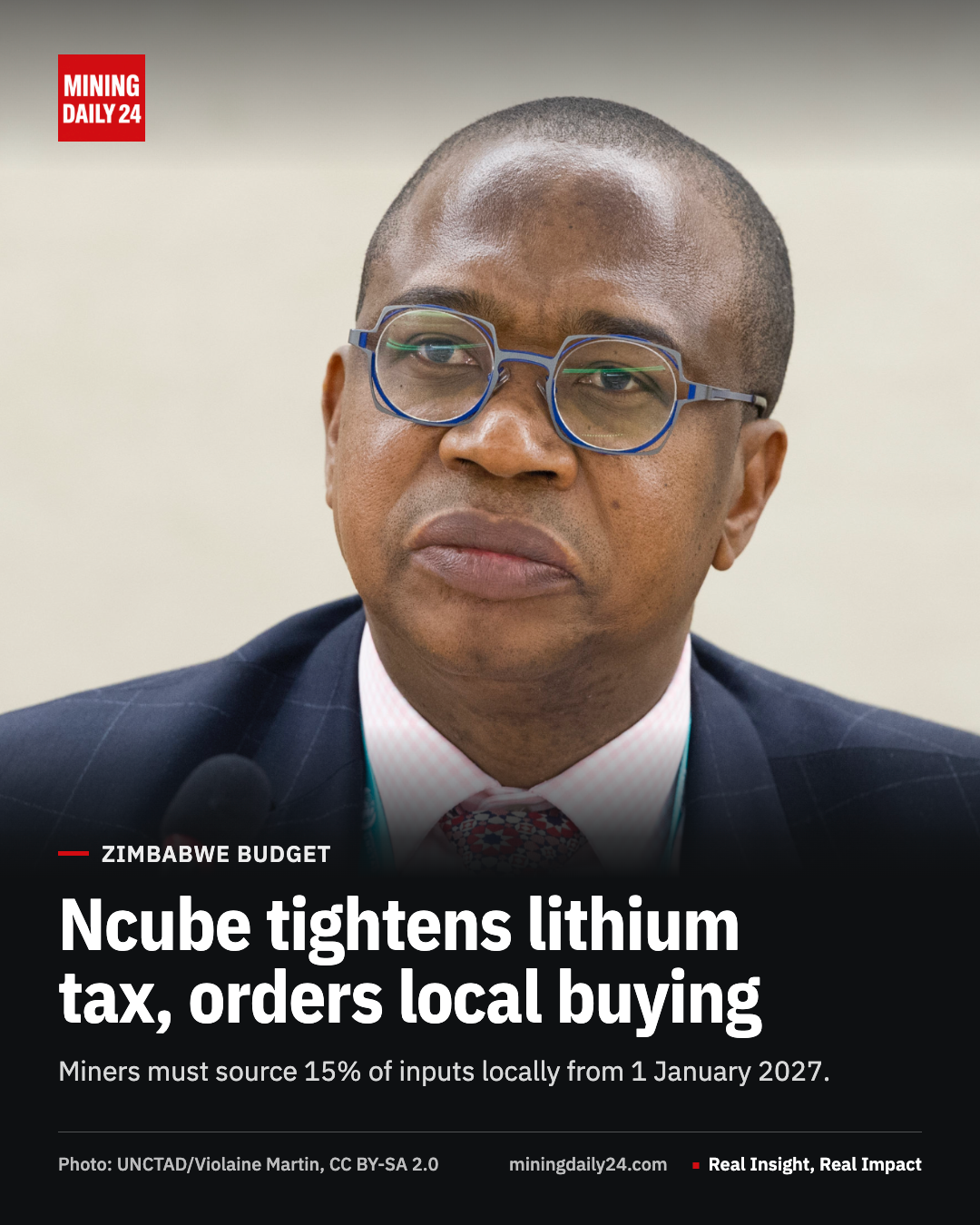
Zimbabwe will tax lithium concentrate exports on the value of the lithium sulphate that could be made from them, and will require mining companies to buy at least 15% of their inputs locally from 1 January 2027, Finance Minister Mthuli Ncube said in his 2027 National Budget on Thursday, 19 November.
The measures are part of a wider reset of mining taxes that rewards processing in the country and raises the cost of shipping raw or semi-processed material.
Lithium taxed on its downstream value
"Effective 1 January 2027, it will be mandatory for the Government, mining companies and all large entities to procure at least 15% of their input requirements domestically, where capacity exists." – Mthuli Ncube, Minister of Finance, Zimbabwe
Until now, export tax on lithium concentrate has been worked out on the declared selling price. Under the new rule, Ncube said, it will be calculated on the gross fair market value of the equivalent lithium sulphate. Benchmark 6% concentrate will be converted at five tonnes of concentrate to one tonne of lithium sulphate, as reported by Reuters. A tax briefing by Lucent Consultancy adds that 5% material converts at six to one and that transport costs cannot be deducted.
Lithium sulphate itself stays at a zero export tax. Ncube did not say whether the ban on concentrate exports due in January 2027 will go ahead, after producers asked for it to be pushed back to July 2027.
According to an industry report cited by Reuters, Zimbabwe's lithium sulphate output is projected to reach 208,000 tonnes in 2027 as new plants start up, while concentrate output is expected to rise to 2.3 million tonnes from about 2.2 million tonnes this year.
15% local content for miners
"Effective 1 January 2027, it will be mandatory for the Government, mining companies and all large entities to procure at least 15% of their input requirements domestically, where capacity exists," Ncube said, as reported by allAfrica. A framework to guide the rule is due by 31 March 2027.
Gold, PGMs and diamonds
According to Lucent Consultancy's reading of the budget and Finance Bill, the 10% gold royalty will apply only to the value above US$5,000 an ounce. PGM exports face a tiered tax from 1 January 2027: 10% on washed ore, 5% on concentrate, 2.5% on matte, 1% on PGM-rich concentrate with base metals and 0% on refined individual metals. Diamonds move from a flat 10% royalty to 5% below US$100 a carat and 10% on value above that.
Ncube also said government paid US$229.7 million in cash and tax credits to platinum miners between January and September against claims for unpaid export proceeds, according to Reuters. The budget projects mining growth of 5.1% in 2027, after 5.3% this year.
Why it matters
Zimbabwe is Africa's largest lithium producer and home to PGM, gold and diamond operations run by Zimplats, Unki, Mimosa, Caledonia and the Chinese-owned lithium miners. The sulphate-based tax and tiered PGM rates push producers to process in the country, and the 15% local-content rule opens a new market for local manufacturers, while suppliers based in South Africa may need local partners to keep their share.
Sources: Reuters via Mining Weekly; allAfrica; Lucent Consultancy.